
From Oil-Producing Countries to Worldwide: Contributing to a Stable Petroleum Supply
Achieving a decarbonized society is an urgent issue. While various efforts, such as energy conservation and adopting renewable energy, are being made, many sectors still depend heavily on fossil fuels, emitting carbon dioxide. Petroleum is an indispensable resource in our daily lives, not only as fuel for power generation, transportation, and home heating but also as a raw material for plastics and synthetic fibers.
Most countries around the world rely on imports for a significant portion of their petroleum, with a large share of crude oil sourced from the Middle East. Ensuring a stable petroleum supply requires safe and efficient transportation methods, and VLCCs play a crucial role in this process.
“VLCC” stands for “Very Large Crude Oil Carrier,” precisely what its name implies — a massive vessel designed to transport crude oil.
To grasp the scale of VLCCs, let’s explore the different sizes of crude oil tankers. Starting from the smaller types, we have “Handymax” vessels, which have a deadweight tonnage (DWT) of 35,000 to 45,000 tons. This relatively small size allows them to easily enter and exit many ports worldwide. Next is the “Panamax” category, with a capacity of 55,000 to 80,000 DWT, designed to be the maximum size that can pass through the Panama Canal. Following that is the “Aframax,” with a capacity of 80,000 to 120,000 DWT. It derives its name from the AFRA freight rate index. Afterward comes the “Suezmax,” which has a 120,000 to 200,000 DWT capacity and represents the largest size that can transit through the Suez Canal. Finally, we have the VLCC, which was first introduced in the 1960s and ranges from 200,000 to 300,000 DWT.
Until the 1970s, even larger tankers, known as ULCCs (Ultra Large Crude Oil Carriers), with capacities of 500,000 tons, were used. However, since the oil crisis, VLCCs have become the primary vessels for transporting crude oil across global shipping routes.
There are specific reasons why VLCCs continue to be used.
The most efficient maritime routes between the Middle East and major importing regions often pass through the Strait of Malacca and the Singapore Strait. However, parts of these routes have shallow waters, with depths of just over 20 meters, making it risky for ULCCs to navigate. Therefore, ULCCs with a capacity of 500,000 tons cannot pass through these routes. Taking a detour would require additional days at sea, and the extra cost could reach tens of millions of dollars. Meanwhile, VLCCs can safely navigate these shortest routes.
As of 2025, leading maritime operators manage fleets of VLCCs worldwide, including spot charters (vessels contracted on a per-voyage basis).
Let’s delve deeper into VLCCs, starting with their immense size.
The 300,000 DWT class VLCCs are approximately 340 meters long — roughly the height of the Eiffel Tower laid on its side. They are over 100 meters longer than a modern cruise ship, which typically measures around 230 meters. From the bottom of the hull to the top of the deck structure, the height exceeds 60 meters, equivalent to a 20-story building.
Managing Crude Oil Safely and Precisely in the Cargo Tanks
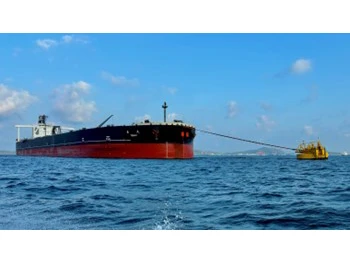
The deck of a VLCC is mostly clear, with visible pipes and fittings. Crude oil is stored and transported in tanks within the hull. A typical VLCC is equipped with 17 cargo oil tanks. The chief officer, responsible for loading operations, manages the types and quantities of crude oil in each tank.
Crude oil varies in density, sulfur content, and other properties depending on the oil field where it is produced. There are approximately 300 types of crude oil, and some cannot be mixed during transportation due to their potential negative impact on refining processes. As a result, crude oil must be transported separately in different cargo tanks based on its characteristics.
Additionally, in the event of an accident, the environmental impact of an oil spill would be catastrophic. To mitigate this risk, VLCC hulls are designed with double structures. The outer layer of the cargo oil tanks is surrounded by ballast water tanks, which hold thousands of tons of seawater to stabilize the vessel. This double-hull design acts as a safeguard to prevent oil spills.
During loading operations (transferring crude oil from land to the vessel), the manifold (the connection point between the vessel and the shore) located in the central part of the vessel is connected to an onshore pipeline. The crude oil sent from the shore is monitored in the cargo control room using remote-level gauges. Finally, an ullage measurement tool (UTI gauge) is inserted into the ullage hole (an opening for measuring the distance between the liquid level and the tank ceiling) to ensure the tank is filled to the target level.